When it comes to getting foundations right in Melbourne construction, the conversation usually lands on two main systems — screw piles and bored piers. Both do the same job at a high level, which is supporting structural loads deep into stable ground, but the way they get there, the gear involved, and where they’re best used can be very different.
For builders, developers, and owner-builders, picking the right system early can save a heap of time, avoid rework, and keep the job moving without dramas.
At Superior Land Excavations, we see both systems used across Melbourne sites daily, from tight backyard builds to large-scale commercial slabs.
This guide breaks down screw piles vs bored piers in a straight, practical way so you can make the right call for your next project.
Before getting into comparisons, it helps to keep it simple.
Screw piles are steel piles with helical plates that are literally screwed into the ground using hydraulic torque equipment. Think of it like driving a giant steel corkscrew into the soil until it hits the required depth and load capacity.
They’re commonly used across Melbourne for:
Once installed, they’re ready to load pretty much straight away with no curing time needed.
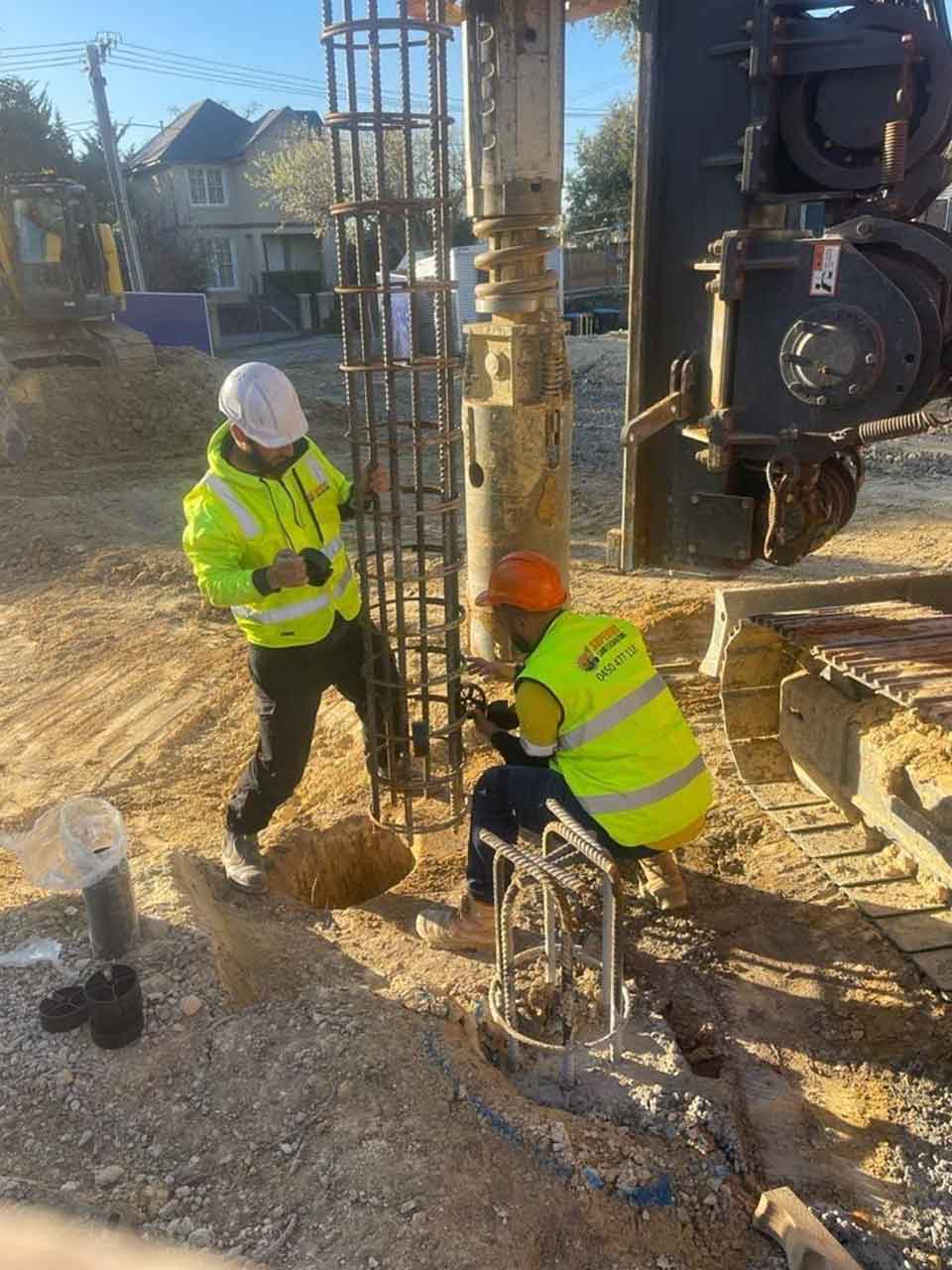
Bored piers are formed by drilling a hole into the ground, installing reinforcement (reo cage), and filling it with concrete. They transfer loads deep into stable soil or rock layers.
They’re commonly used for:
They’re a more traditional system, but still heavily used across Melbourne because of their strength and flexibility.
Melbourne isn’t one-size-fits-all when it comes to soil. Anyone working in the industry knows you can hit reactive clay in one street, fill in the next, and rock a few metres down. That’s where the choice between screw piles and bored piers really kicks in.
Common ground conditions we deal with include:
Both systems can work across these conditions, but the application changes depending on load, access, and engineering requirements.
Screw piling really shines when access is tight or the job needs to move quickly.
On Melbourne sites, especially inner suburbs or knockdown-rebuild blocks, getting big gear in isn’t always possible. That’s where screw piles come into their own.
It’s a “get in, get it done, get out” system.
If the job is a backyard extension in a tight Hawthorn or Brunswick block, screw piles usually make life easier for everyone on site.
Bored piers are still the go-to when things need serious load support or deeper ground anchoring.
They’re slower than screw piles, but they’re solid as a rock when done properly.
You’ll see bored piers used a lot on new home builds across Melbourne growth corridors where slabs need consistent support across reactive ground.
It’s the “old reliable” of foundation systems — simple, proven, and strong.
There’s no flat answer here because every site is different, but a few key factors drive cost differences between screw piles and bored piers.
As a general rule, screw piles can be more cost-effective on smaller or tight-access jobs, while bored piers often suit larger structural projects where bulk drilling is already part of the program.
Both systems perform well when designed properly, but they shine in different ways.
It really comes down to matching the system to the job instead of forcing one method across everything.
Before locking in a piling system, most experienced builders and site supervisors look at:
A good contractor won’t just push one system, it’s about reading the job properly and keeping it practical on the ground.
On some Melbourne projects, it’s not an either-or situation.
You’ll often see:
This hybrid approach is common in townhouse developments and complex residential builds where different parts of the structure demand different support.
At Superior Land Excavations, we work across both systems every day, helping builders and developers get the right foundation in the ground with safe construction practices without delays, guesswork, or rework. If you’re planning a project and need straight advice on piling, it pays to get it sorted early.
Get in touch with us today for practical piling solutions across Melbourne.
This article is provided free of charge for public information. We do not guarantee, and accept no legal liability for, the accuracy, reliability, currency, or completeness of the content or any linked material. Users should apply their own judgment and verify the material’s relevance to their needs. This article is a general summary and not a substitute for legal or professional advice. Users should seek appropriate advice for their circumstances. Any third-party views expressed do not necessarily reflect ours or imply endorsement.
Very happy with Superior Excavation. They were professional to deal with and responded to emails and calls promptly. Thanks again for your help. Definitely recommending to my friends.
Very happy with Superior Excavation. They were professional to deal with and responded to emails and calls promptly. Thanks again for your help. Definitely recommending to my friends.
I would like to thank you for your quick and accurate work - excavation of our new house in Ivanhoe. I am very impressed that you prepared the site in two days. It was great dealing with you
Copyright ©2026 superiorlandexcavations.com.au
 IT BOOST AUSTRALIA